The place
The cathedral and its Oratory
A short history of St John's Co-Cathedral in Valletta and its Oratory: who built it, who decorated it, and why the plain front hides so rich an interior.
Book the Caravaggio performance ↗Quick answer
St John's Co-Cathedral was built by the Order of St John between 1573 and 1578 in the new city of Valletta, to a design by Girolamo Cassar. Its plain, fortress-like front hides a richly decorated Baroque interior, mostly the work of Mattia Preti in the 17th century. The Oratory, finished in 1604, holds Caravaggio's Beheading of Saint John the Baptist.
A church for a new city
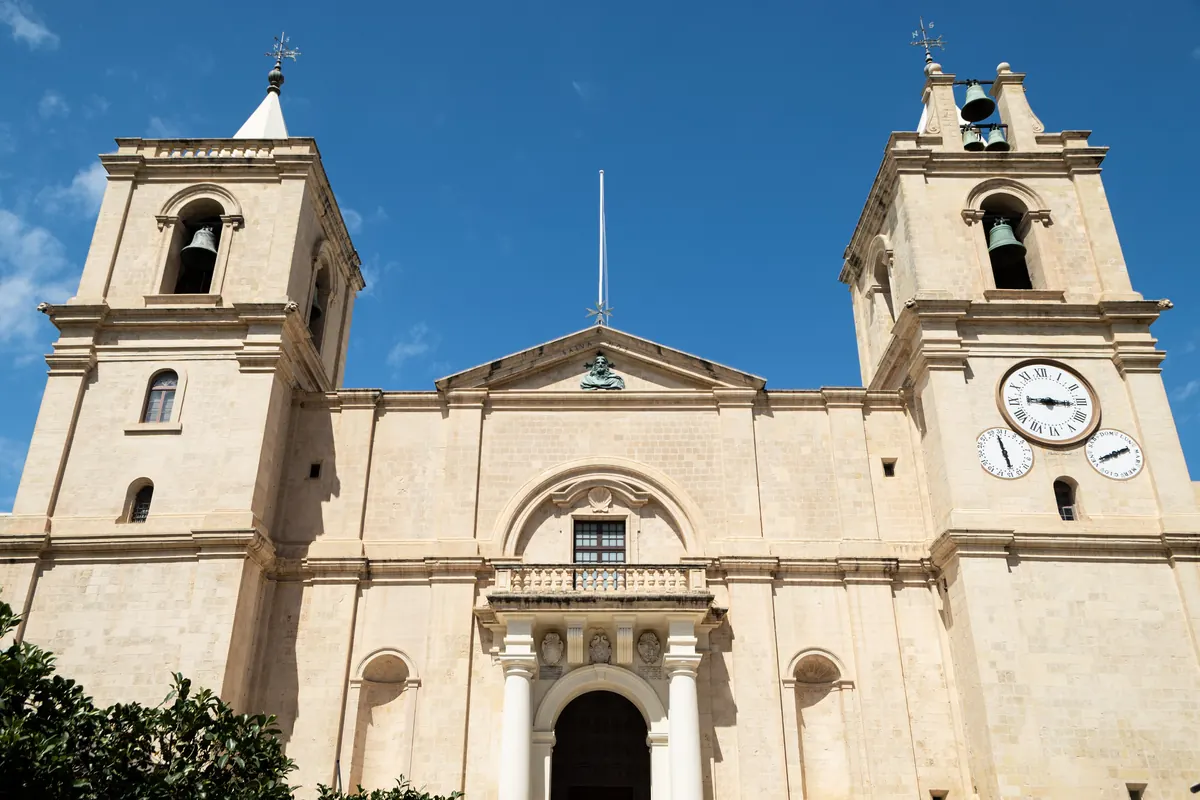
Wikipedia says the church followed the Great Siege of 1565 and was commissioned in 1572 by Jean de la Cassière, Grand Master of the Order of St John. Valletta itself was begun after the siege, named after the Grand Master who defended the island, Jean Parisot de Valette, and Wikipedia gives 28 March 1566 for the laying of its foundation stone. The cathedral became the Order's conventual church once it was completed in 1577.
A plain front
Wikipedia says the architect was the Maltese Girolamo Cassar, who designed and oversaw many of Valletta's important buildings. The exterior is in the Mannerist style, rather plain but well proportioned, bounded by two large bell towers, with a doorway flanked by Doric columns and an open balcony from which the Grand Master addressed the people. Wikipedia calls it austere and reminiscent of a fortress, reflecting its architect's work as a military engineer and the Order's mood after the siege.
The Baroque interior
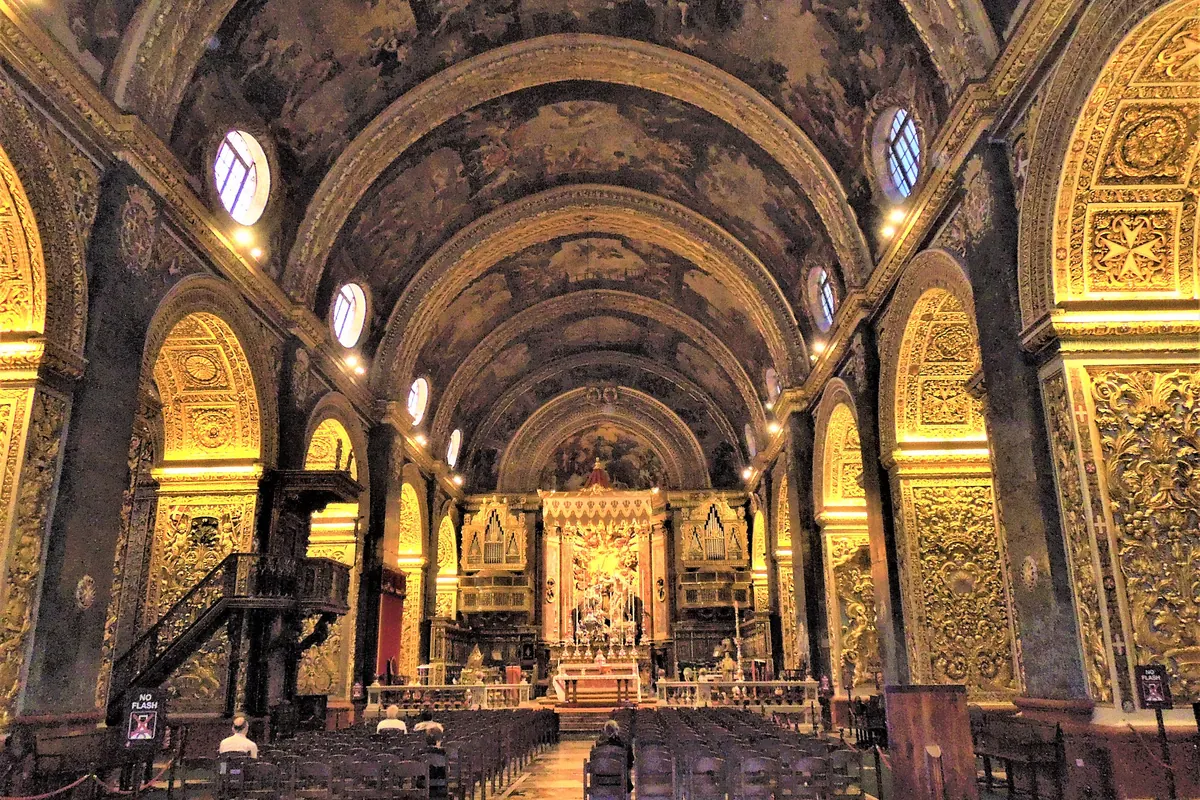
Wikipedia says that for the first century the interior was modestly decorated. In the 1660s Grand Master Raphael Cotoner ordered a redecoration to rival the churches of Rome, and the Calabrian artist Mattia Preti transformed the interior in the Baroque style. He designed the carved stone walls and painted the vaulted ceiling and side altars with scenes from the life of John the Baptist. Wikipedia calls the result one of the finest examples of high Baroque architecture in Europe.
Mattia Preti, the Calabrian Knight
Wikipedia says Preti was born in 1613 in Taverna in Calabria, worked in Italy and Malta and was called Il Cavalier Calabrese after he was appointed a Knight of the Order in 1660. In Rome he came to know the techniques of Caravaggio and his followers, and his early works used sharp contrasts of shadow and intense light. It makes a neat link: the painter who dressed the cathedral learned from the painter whose masterpiece hangs in its Oratory.
The floor and the chapels
Wikipedia says the nave floor is a collection of marble tombstones in which important knights were buried, richly decorated with inlaid marble and coats of arms, with the more important knights closer to the front. The side chapels belonged to the Order's national groups, called langues, such as Provence, France, Italy and Germany, and hold altarpieces and tombs of Grand Masters. A daytime visit walks over and between all of this, which the evening performance does not cover.
The Oratory
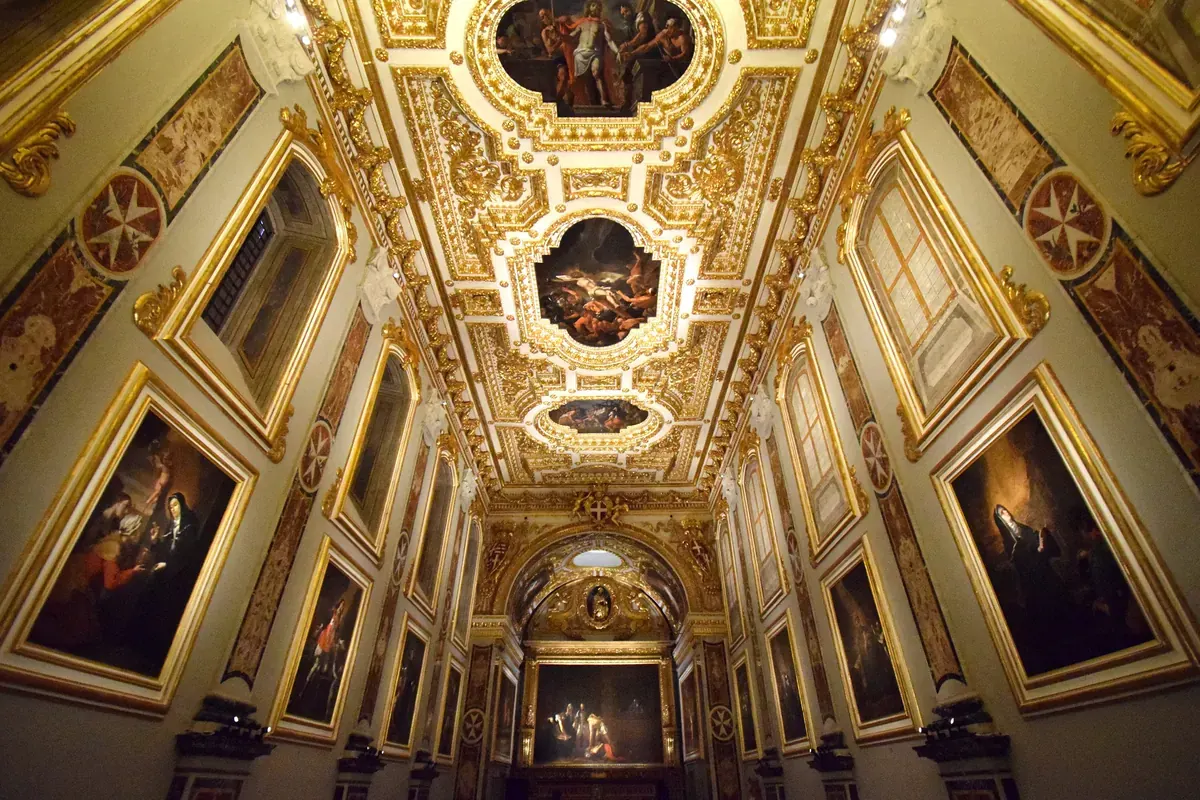
Wikipedia says construction of the oratory and sacristy began in 1598 under Grand Master Martin Garzez and was completed in 1604 by Alof de Wignacourt. The Oratory holds Caravaggio's Beheading of Saint John the Baptist and his Saint Jerome Writing. This is the room used for the evening performance, which the booking page calls site-specific: the music and the story are staged in the room where the painting hangs.
Read next: Caravaggio concert in Valletta
From conventual church to co-cathedral
Wikipedia says the church remained the Order's conventual church until the Order was expelled from Malta with the French occupation in 1798. In the 1820s the Bishop of Malta was allowed to use it as an alternative see, and it formally became a co-cathedral. It escaped total destruction in the bombing of 1941, according to the same article, because its contents had been moved elsewhere, and in 2001 a foundation was set up to administer and conserve it.
A visitor's verdict from 1831
Wikipedia records that in 1831 Sir Walter Scott called the cathedral a magnificent church, with the most striking interior he had ever seen. A modern visitor can test that against the contrast between the fortress-like front and the golden, painted interior. The Wikipedia article also says the cathedral is one of the most popular tourist attractions in Malta and is listed on the National Inventory of the Cultural Property of the Maltese Islands.
Who this isn't for
This is a short history, written for visitors, not a guide to the cathedral's archives or to the art of every chapel. Readers who want a room-by-room tour should use a daytime visit with an audio guide, or the after-hours guided tour, which is a separate booking. Opening days and hours are not given here because they change, and the cathedral closes to sightseeing during services, so check its own website before you plan a daytime visit.
Frequently asked questions
Who built St John's Co-Cathedral?
The Order of St John, between 1573 and 1578, to a design by the Maltese architect Girolamo Cassar, says Wikipedia.
Who decorated the interior?
Mostly Mattia Preti, from the 1660s, who painted the ceiling and designed the carved stone walls in the Baroque style.
What is the Oratory?
A room begun in 1598 and finished in 1604. It holds Caravaggio's Beheading of Saint John the Baptist and Saint Jerome Writing.
Why is it called a co-cathedral?
Wikipedia says the Bishop of Malta was allowed to use it as an alternative see in the 1820s, so it formally became a co-cathedral.
Where is the evening performance held?
In the Oratory, according to the booking page, with 30 minutes to view the cathedral beforehand.
Sources